
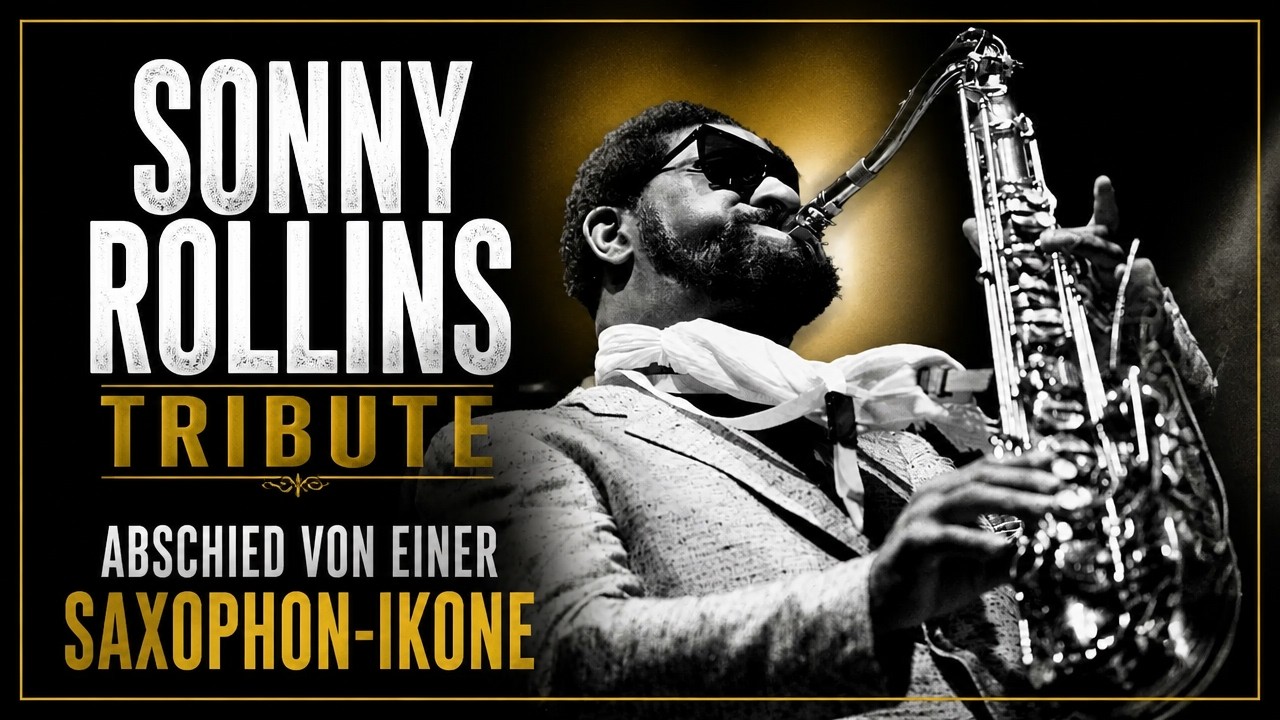
Walter Theodore Rollins (born September 7, 1930, in New York City; died May 25, 2026, in Woodstock, New York), known worldwide as Sonny Rollins, shaped modern jazz like few others. As one of the last great pioneers of the bebop era, the tenor saxophonist and composer released over 60 albums of his own since the late 1940s. His influence on the music world was monumental: Rollins freed improvisation from the rigid constraints of the musical theme. With a blend of pure energy and subtle humor, he created endless, associative chains of melodies, which led to his legendary solo concerts as early as the mid-1960s.
His trademark was a powerful, unmistakable sound paired with melodic inventiveness and technical brilliance. He also possessed the rare gift of effortlessly mastering even the most complex rhythms and steering them into entirely new musical realms.
[00:00] My One and Only Love
[02:03] St. Thomas
[03:45] It Don´t Mean a Thing
[05:41] Promise
[07:55] The Bridge
[09:16] A Weaver of Dreams
[11:32] Don´t Stop the Carnival
Meine Onlinekurse: https://my.saxvideotraining.com
Wenn du neu hier bist klicke hier Abonnieren: https://bit.ly/2ICgEEO
EMAIL: info@saxvideotraining.com
MESSENGER: https://m.me/saxbrig
Bin richtig traurig.
Ja find ich auch traurig
Einfach nur sehr geil
96 ein stolzes Alter ❤
ich hab ihn vor einigen Jahren noch live gesehen
Rip Sonny
Ein exzellenter Musiker und ein feiner Mensch ist von uns gegangen. Ruhe in Frieden, Sonny! Vielen Dank, lieber Bernd, für diese schöne Hommage!
Respekt vor seinem erreichten Alter und vor seinem musikalischen Talent auf dem Tenor Sax. Gigantischer Sound. 🎷
“ Sonny could take any tune and play it like he wrote it “ John Coltrane
Thank you from the bottom of my heart. Danke
Thank you too.
I can’t find this recording of Promise btw at 5:41. Where did you get it?
Here is the link: https://youtu.be/iLegqBpHxAg?si=bBk0_l8Tf2If5jIV
I listened to a 10-hour French radio program dedicated to Sonny Rollins (yes, 10 one-hour episodes, covering the period 1951-2001!). Its title is „Sonny Rollins, the Intoxication of Solitude.“ You can find it on Google. It was pure torture, but that’s how I do things: I immerse myself in an artist and listen to everything, or almost everything, to form my own opinion. My opinion of Rollins? He seems very overrated to me.
As a musician/improviser,
First of all, as a musician/improviser, he doesn’t seem to me any better than Johnny Griffin, Sonny Stitt, Roland Kirk, Phil Woods, Lateef, Pharoah Sanders, Hank Mobley… and yet, he enjoys a much greater—and in my opinion, unjustified—fame. Certainly, he plays well, but not better than the musicians mentioned. Listen to „Eternal Triangle,“ which brings Rollins and Stitt together. Technically, their performances here are very similar, but Rollins is the more famous one today. His solos have been the subject of much study and are generally considered examples of powerful thematic construction and development. This implies that the others play haphazardly. I’m not entirely convinced by this argument. If you appreciate his style, that’s a good thing; if you think it’s an excuse for repetition, you’ll disagree.
As a composer,
in terms of composition, he didn’t compose anything. Everyone knows that his hit „St. Thomas“ is a Caribbean folk tune already recorded by Randy Weston in 1955 under the title „Fire Down There.“ „St. Thomas“ is an example of cultural transfer. It was originally „The Lincolnshire Poacher,“ an old English folk song. It was taken to the Caribbean, probably on slave ships, but perhaps even earlier by pirate ships (which is fitting given its title). The piece evolves into a Caribbean folk tune, and then Rollins remembers hearing it sung by his mother during his childhood and renames it after the island. I thought his mother called it St. Thomas, but your information seems to indicate otherwise. Interestingly, the Ted Heath Band, a British big band from the 1950s, had some success with „The Lincolnshire Poacher,“ presumably a response to St. Thomas. Their piece „Tenor Madness“ is a Kenny Clarke composition published in 1947 under the title „Rue Chaptal.“ As for his other compositions from the 1950s—Oleo, Airegin, etc.—they are incomparable to those of Trane, Bird, Monk, or Shorter. One detail that has always struck me, and that no one else has mentioned, is that the theme for Alfie is simply a reinterpretation of the introduction to „Singing in the Rain“!
Sound and Artistic Vision
I find this curious. From his early days in the 1950s, his sound was already quite distinctive, but it became even more so later on. It’s an unusual sound for a tenor saxophone, but I hear it used more and more often by saxophonists. I don’t really know how he manages it or if there’s a physiological reason for it. I’ve found it’s something you acquire. Moreover, his playing and sound deteriorated terribly after 1966 (36 years later). Something happened at that point; he lost his mind. He seems to have been traumatized by the arrival of Ornette, Trane, Ayler… In the ’60s, he tried to be freer than Ayler, more calypso/blues than Ornette, and more mystical than Trane, but he couldn’t manage it because it was too superficial… Then, in the ’70s and ’80s, he experimented with funk and disco… with truly ridiculous and cheesy results… Did he want to be funkier than James Brown himself? More disco than Chic and Nile Rodgers? On „SAIS,“ from the album „Horn Culture,“ just one example among many, chosen at random from between 1966 and 2001… It’s a disgrace. He plays out of tune, off-beat, with an absolutely disgusting sound. It’s disrespectful to himself, the other musicians, and the listener. No self-respecting musician would have agreed to the release of such a recording. The problem with Rollins is that EVERYTHING IS LIKE THAT after 1966. He even admitted himself to being under the influence of cannabis during the recording of his solo album „Soloscope“ at MoMA. From New York… Listen to the result; it’s ridiculous and disrespectful to the listeners…
Ego and Money
Furthermore, on the radio show, they say he was paid $300,000 (the amount we know he’s worth today) to record the album Nucleus (listen to the result!), and that his requests for funding for his concerts were unrealistic; only the major festivals could afford it. He played with the Stones, but refused to tour with them because, according to Mick Jagger himself, he was too expensive! I’m not making this up. In a blind test published in Downbeat in 2006
Colossus
Sonny the great ❤
Absolut, er ist eine echte Legende! 😊